AIAI-HRM helps organisations understand where human cyber risk arises, why behaviour occurs and which change actually helps. From isolated awareness activities to structural behavioural improvement.
Many organisations already invest in security awareness and phishing campaigns. Employees complete training, campaigns are delivered and results are measured. Yet it often remains unclear whether the most important human risks are actually decreasing.
Secure behaviour is not determined by knowledge alone. Workload, processes, available resources, habits, leadership behaviour and organisational culture also shape what people do in practice.

For us, Human Risk Management does not start with training, a phishing campaign or a technology platform. We first look at where human actions influence cyber risk and which behaviour plays a role.
We look beyond knowledge alone. Workload, processes, available resources, habits, leadership behaviour and organisational culture also determine whether people can and want to act securely in practice.
We use existing signals, such as awareness results, phishing data, incidents and policies, where relevant and add targeted information where gaps remain. This creates a substantiated view of what truly needs attention.
We then translate this into a limited number of concrete improvement priorities. The intervention follows the risk. Sometimes training is the right step, but sometimes a process change, clearer communication, technical support or different leadership behaviour works better.
Find out where your organisation stands in about 6 to 8 minutes. Answer 18 practical questions across six areas of Human Risk Management and get an immediate first view of your maturity.
You see your maturity level, scores across the six dimensions and three key points of attention. Not a technical audit, but an accessible first self-assessment.

The result is indicative and based on your own answers. The in-depth Human Risk Baseline contains the substantiated risk analysis and 90-day plan.

The Human Risk Baseline identifies where human cyber risk arises and which behaviour influences it. We use existing information where useful and add targeted measurements and context where needed.
Outcome: a Human Risk Scorecard, two or three concrete improvement priorities and an actionable 90 day plan.
Start with insight →After the Baseline, structural improvement begins. AIAI-HRM follows relevant signals, helps set priorities, organises targeted interventions, measures progress and translates results into clear management information.
The intervention follows the risk. That may be training, but also communication, a process change, technical support, coaching or different leadership behaviour.
Discuss Managed Human Risk →

Measurements, campaigns, signals and reporting are supported efficiently wherever possible. AIAI-HRM remains responsible for interpretation, prioritisation, intervention choices and management advice.
Human cyber risk requires increasing attention. Yet in many organisations, Human Risk Management is not a dedicated function. Responsibility often sits with IT, security, HR, privacy or compliance alongside regular work.
The motivation is usually there, but not always the time, specialist knowledge, capacity, tooling and structure needed to connect awareness, phishing, policies, behaviour and reporting and follow them up structurally.
AIAI-HRM works as a specialist extension of the organisation. We add Human Risk expertise, methodology and governance, connect to what is already in place and help interpret results, set priorities, organise improvements and make progress visible.
AIAI-HRM helps organisations organise Human Risk Management professionally, without needing a complete specialist team internally.
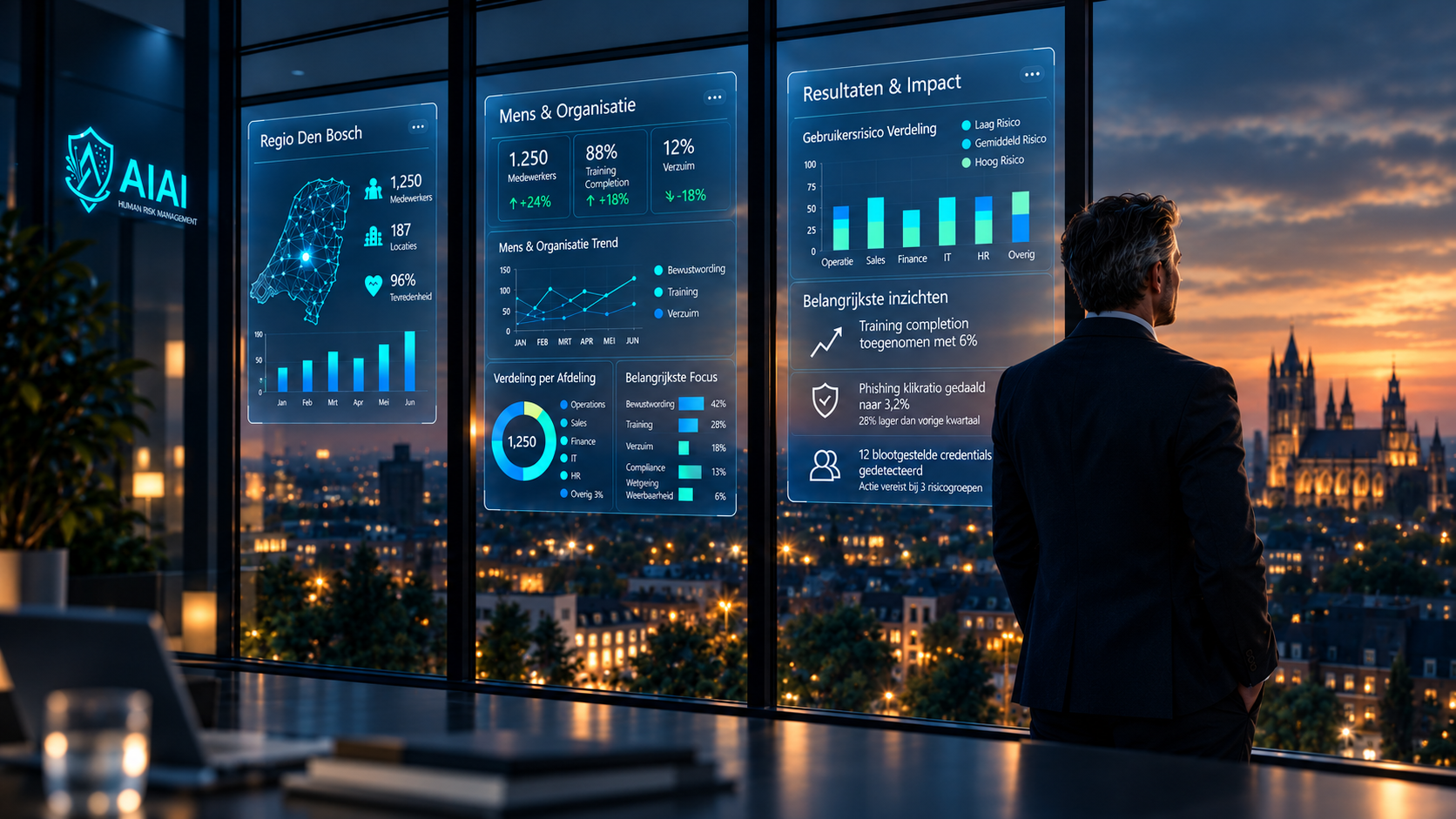

Your IT or security partner remains responsible for the technical environment and knows the systems and customer context. AIAI-HRM adds specialist expertise around human risk, behaviour and culture.
This keeps roles clear and creates a more complete picture of cyber risk, without unnecessarily changing existing relationships or responsibilities.
More about working with partners →